Welcome: Jiangsu Hongjing Metal technology Co.,Ltd







yolanda@hongjingmetal.com +86-15358997067
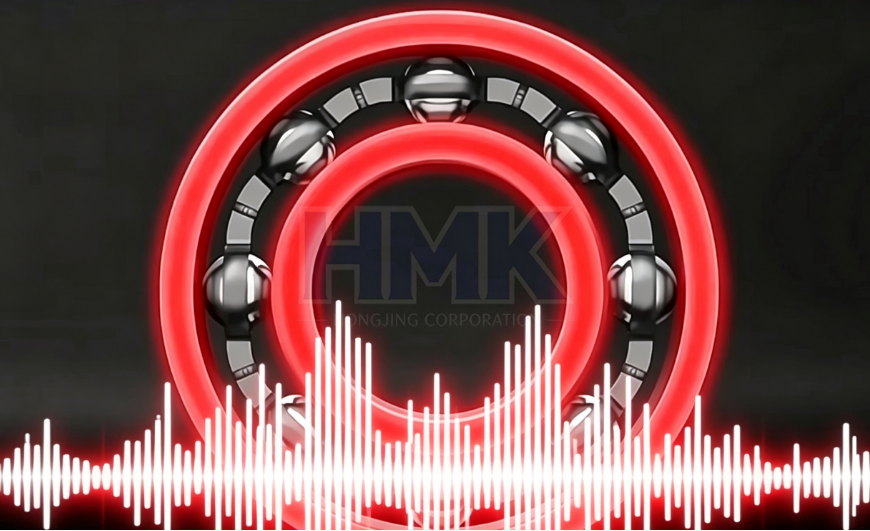
Abnormal noise and vibration are the most intuitive signs of bearing failure.
Bearing abnormal noise and excessive vibration are the most common early warning signs of rolling bearing failure in industrial machinery, motor systems, conveyor equipment, and EV powertrain units. Undetected minor faults will gradually cause raceway spalling, rolling element damage, overheating, and unexpected equipment downtime.
Different noise types represent different faults. Continuous slight noise usually indicates insufficient lubrication. Impact noise represents rolling element wear and peeling. Irregular loud noise means serious abrasion or foreign body entering.
Professional vibration detection and noise diagnosis can quickly locate bearing faults without disassembly.
This guide shares practical, field-proven methods to diagnose bearing abnormal noise and vibration faults without professional complex instruments. It helps engineers, maintenance teams, and buyers quickly locate root causes and apply correct solutions, extending bearing service life and reducing operational costs.
1. Normal VS Abnormal Bearing Sound & Vibration
A healthy precision rolling bearing generates a smooth, uniform low-frequency "whooshing" sound with stable, low-amplitude vibration during operation. Any sudden change in sound tone, noise intensity, or vibration amplitude indicates internal defects or installation errors.
Common Abnormal Noise Types & Primary Causes
Hissing continuous sound
Root cause: Insufficient lubrication, dry grease, or too small internal clearance. Frequently occurs in high-speed miniature bearings and sealed ball bearings.
Periodic rhythmic rumbling/knocking
Root cause: Scratches, corrosion spots, spalling on raceways or rolling elements. The noise frequency is directly proportional to shaft rotation speed.
Irregular scraping/chattering
Root cause: Dust, metal debris, or particulate contamination inside the bearing cavity.
Coarse rasping noise
Root cause: Loose fit between inner ring & shaft or outer ring & housing, excessive mounting clearance.
Vibration Baseline Reference
Normal industrial bearing vibration velocity: 2.8–4.5 mm/s (medium-speed operation).
A sustained rise above 7.0 mm/s confirms a definite bearing fault requiring immediate inspection.
2. 4-Step Field Diagnosis for Bearing Noise & Vibration Faults
This step-by-step workflow is designed for on-site rapid detection, compatible with both auditory inspection and basic vibration testing.
Step 1: Preliminary Auditory Inspection (Zero-Cost Detection)
Use an industrial stethoscope or solid listening rod to contact the bearing housing. Compare the operating sound with the normal baseline:
• Uniform soft hum = healthy status
• Fluctuating loud noise = early-stage surface damage
• Sharp intermittent knocking = severe rolling element/raceway wear
Tip: Auditory inspection works best for medium-low speed equipment; high-speed EV bearings require vibration instrument verification.
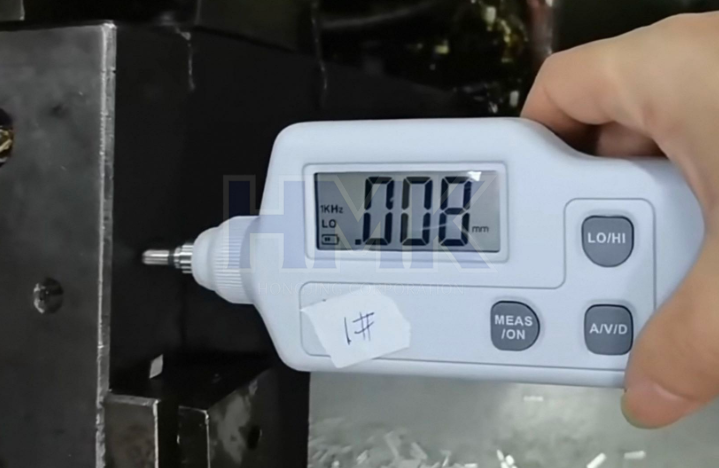
Step 2: Vibration Data Measurement & Frequency Analysis
For accurate fault localization, use a portable vibration analyzer to capture frequency signatures. Core bearing defect frequencies include:
• BPFO (Outer Race Fault Frequency)
• BPFI (Inner Race Fault Frequency)
• BSF (Rolling Element Fault Frequency)
• FTF (Cage Fault Frequency)
If these characteristic frequencies appear with harmonics and sidebands, the corresponding component has irreversible mechanical damage.
Step 3: Auxiliary Check (Temperature & Lubrication)
• Temperature rise >15°C above normal operating level: aggravated wear or over-lubrication
• Grease discoloration, blackening or metal powder mixing: internal abrasion and contamination
• Oil leakage from sealed bearings: insufficient lubricant leading to dry friction noise
Step 4: Disassembly Confirmation (For Persistent Faults)
If noise and vibration remain after lubrication adjustment, disassemble the bearing to check for:
Indentations, rust, cage deformation, clearance over-tolerance, or improper mounting marks.
3. Root Causes & Targeted Solutions
Fault Phenomenon Root Cause Recommended Solution
Hissing noise + high temperature Insufficient/deteriorated lubricant Clean bearing cavity, refill with matched viscosity grease
Periodic rumbling Raceway/rolling element spalling Replace bearing; check shaft alignment
Random scraping noise Internal particulate contamination Flush sealed bearing or replace with dust-proof type
High overall vibration Loose fitting / misalignment Recalibrate mounting tolerance; re-shaft positioning
Low-frequency cage knocking Cage deformation Replace bearing to avoid sudden seizure
4. Pro Tips to Prevent Recurring Bearing Vibration & Noise
1. Select precision-grade bearings (P6/P5) for high-speed and vibration-sensitive equipment to reduce inherent runout.
2. Follow standardized mounting: avoid hammer direct impact; use thermal mounting for large bore bearings.
3. Implement regular lubrication cycles: over-greasing also causes high vibration and heat buildup.
4. For harsh dusty/wet environments, adopt double-shielded (2Z) or sealed (2RS) bearing configurations.
5. Set monthly vibration baseline tracking to capture early faults before noise becomes audible.
Conclusion
Diagnosing bearing abnormal noise and vibration faults relies on combining auditory judgment, vibration frequency analysis, and lubrication status checks. Early detection can prevent 80% of premature bearing failures and unexpected machine shutdowns.
For high-precision, high-speed, and corrosion-resistant bearings with stable vibration performance, contact HMK Bearing to get professional selection and maintenance guidance for your industrial and EV applications.
Contact: Yolanda
Phone: +86-15358997067
E-mail: yolanda@hongjingmetal.com
Add: No.88, Qianyao Road, Binhu District, Wuxi, China
LiveChatclose
 Send Email
 Skype
Skype WhatsApp